Showing posts with label Didactic Units. Show all posts

Wednesday, 27 May 2015

HOW DO WE EXPRESS EMOTIONS AND FEELINGS?

Image taken from http://infinityhousemagazine.com.


VOCABULARY

LET'S LEARN DIFFERENT WAYS OF EXPRESSING THE WAY WE FEEL

There are different words in English to express how we feel. We can use adjectives to describe our feelings and emotions, but we can also express them using everyday expressions, idioms, etc.

Here you can find different adjectives expressing emotions and feelings:
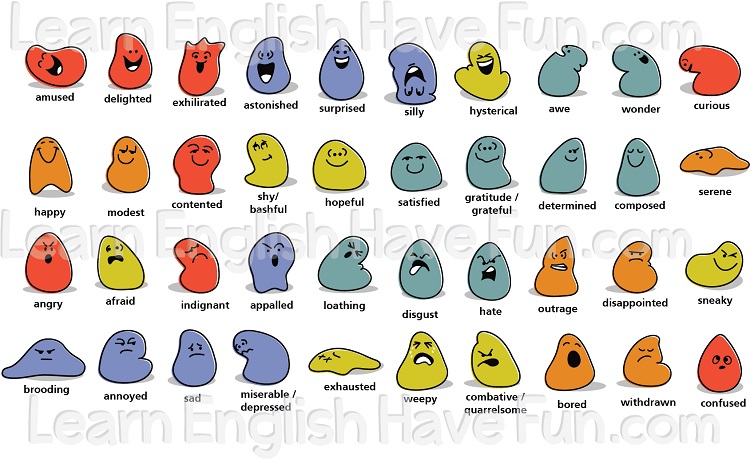
Image taken from http://www.learn-english-have-fun.com.


PRONOUNCIATION


SPEAKING

So how are you feeling today...?

Imagine you're in the following situations. How do you feel? Make as many sentences as you can in three minutes using this vocabulary and the images below:

Resultado de imagen de fail exams
           
Resultado de imagen de fall in love

Resultado de imagen de being a romeria


Next, we're going to practice vocabulary we've learnt about feelings and emotions with this LISTENING ACTIVITY


READING ABOUT TEEN EMOTIONS

Image from http://taltomartyb.com/

Read the text.

Are you frustrated being a teenager? Do you feel like you’ve got a lot of problems to put up with? Well, try and imagine being a teenager 500 years ago.

Teenagers didn’t make decisions about their lives 500 years ago. Important decisions were made for them. A father found jobs for his children and chose their husbands and wives. And parents hit children when they did something wrong.

Most children didn’t go to school. School was for boys from rich families. Poor boys started working when they were very young. They worked on farms or helped in the family business. Sometimes they learned a profession. They usually left the house at 6.00 in the morning and didn’t return until 5.00 in the evening.

For girls, it was tough, too. People believed women weren’t as important as men. A brother always had a higher position than his sisters. Most girls stayed at home and helped their mothers. Only girls from rich families were taught how to read and write.

Was life miserable for teenagers? Well, they had fun, too. Rich boys went hunting. Rich boys and girls enjoyed good books. Rich and poor had music and dancing, and there were many popular games. But for most teenagers, life was very hard work.

So, the next time you’re feeling down, imagine what it was like 500 years ago.


Tick the correct answers. There are ten correct answers.


Who?

                                                     Rich boys         Rich girls      Poor boys     Fathers


  1. made important decisions in the family      
  2. didn’t go to school
  3.  worked on farms
  4. learned to read and write
  5. went hunting
  6. played games
Answer the following questions:
  1. What were the responsibilities of the father?                                                                                                                                                  
  2. Why were children hit?                                                                                                                                               
  3. How many hours a day did poor boys work?                                                                                                                                               
  4. What did most girls do all day?                                                                                                                                                  
  5. What fun activities were there for rich girls?
GRAMMAR REVISION

  Complete the sentences with the verbs in brackets. Use a suitable tense. 
       1.  Tom ……………………………… (not come) to my party yesterday because he was too busy.
       2.  In ten years’ time, there ……………………………… (be) more skyscrapers in the city.
       3.  Next summer, my brother and I ……………………………… (ride) bicycles across Europe.
       4.  We ……………………………… (not see) our cousins since 2007.
      5.  Who ……………………………… you ……………………………… (talk) to when I saw you?
   6.  ……………………………… you ……………………………… (know) the answer to this question?
  2  Complete the sentences with the adverb form of the adjectives in brackets. 
Alice and Jane are sisters. Alice looks like Jane but she does things 1…………………… (different). Alice does everything 2…………………… (fast) Jane. She’s a fast walker and a fast talker. Alice is also noisier than Jane. She talks 3…………………… (loud) Jane, but doesn’t say much. Jane talks very 4…………………… (quiet), but people always listen to her.
  3  Complete the mini dialogues with a suitable question. Pay attention to the words in bold in the answers. 
       1.                                                                                                                                        
Nothing happened.
       2.                                                                                                                                        
The dog ate all the hamburgers.
       3.                                                                                                                                        
I am going to visit my cousin in Canada.
       4.                                                                                                                                        
Elaine has played the piano since she was six.
       5.                                                                                                                                        
The Tower of London was built almost a thousand years ago.
       6.                                                                                                                                        
Yes, they are. Concert tickets are sold in the bookshop.
  Read Angela’s letter to an advice column and the reply she received. Choose the correct answers.
Dear Felicity,
My name is Angela. 1 I is writing / am writing / write to you because I’ve
got a big problem. My younger sister Shelly and I 2 have shared / share /
were sharing a bedroom since Shelly was a baby. I am four years
3 as old as / the oldest / older than Shelly. When we were small it was OK, but now it’s impossible. Shelly always 4 touches / touch / touched my things. Last week, her friends were here. While they 5 were playing /
was playing / are playing in our room, Shelly 6 has showed / shows / showed them my clothes. When I got home from school, all my clothes
7 were thrown / are thrown / was thrown on the floor. I’m so annoyed!
8 Should / Can / Do you help me?
Angela

Dear Angela,
Many siblings 9 shares / are sharing / share a bedroom and it can be tough. Tell Shelly how you feel. Shelly was wrong and she 10 could / can / has to know it. Then you 11 could / should / mustn’t make 12 much / any / some rules for the bedroom. Afterwards, you can work together to create
a bedroom with private space for each of you. If you 13
will do / do / does this, you 14 will feel / feel / feels happier together.
Good luck,
Felicity

SURVEY ON TEEN PROBLEMS

Image taken from http://www.sampabjj.com.

Time flies! This is already the end of this academic year! How's your school life? Have you encountered any difficulties with your studies, families or friends? Do you need any kinds of help? We really want to offer  you help! Go round the classroom and aks your mates the different questions. Please tick the appropriate column or fill in the blanks when neccesary:

Class: ______                                   Gender: (F/M)                                      Age: _______

                                                      Strongly agree (3)  -  Agree (2) -  Disagree (1)  - Strongly disagree (0)
SELF IMAGE:

a. Do you think you are good-looking?
b. Do you think you are clever?
c. Do you think you are hard-working?
d. Do you think you are popular?

FAMILY:

a. Do you love your parents?
b. Do your parents love you?
c. Do you always quarrel with your parents?
d. Do you always quarrel with your siblings?
e. Do you spend a lot of time with your family?

SCHOOL:

a. Do you enjoy going to school?
b. Do you find school work difficult?
c. Are you afraid of studying?
d. Are you afraid of examinations?
e. Do you have confidence in gaining good results?

FRIENDS:

a. Do you have many friends?
b. Do you go out with your friends at weekends?
c. Do you have good relantionship with your friends?

HEALTH:

a. Do you do exercise regularly?
b. Do you eat healthily?
c. Do you think you are healthy?

Now, let's analyse this survey's results. You have to calculate the following:

a. the mode.
b. the average.
c. the median.

WRITING

Think about a time you were angry about something or with someone. Write a diary entry or an e-mail about the situation. Describe what made you angry and how you reacted.

DIGITAL PROJECT

We're going to prepare a digital project to be presented to your classroom, in which you have to look for information about the world's happiest and saddest countries. After, you' have to draw a pie chart in which all the figures have to be represented.

Image from http://www.independent.co.uk.

Here there are some websites which will help you to find the information you need:

http://www.forbes.com/

http://www.livescience.com/
http://www.mindbodygreen.com/

Finally, you have to locate all the countries you have used for your project in the world map. 


WORKING WITH A SONG

PHARREL WILLIAMS' HAPPY

What do you think the song is about from its title, vocabulary or artwork?

Let's listen to the song, and pay attention to the lyrics:


NOW, EXPRESS HOW YOU'VE FELT WHILE WORKING WITH THIS DIDACTIC UNIT!


Wednesday, 29 April 2015

SAVE THE WORLD!!!

LET'S DO SOMETHING TO HELP THE ENVIRONMENT


This term we're going to work with contents in relation to ENVIRONMENT AND POLLUTION.


VOCABULARY


Let's start with some useful vocabulary about environmental issues with brainstorming about what we can do to prevent the Earth from being destroyed: 


Now, let's see a presentation with words related to this topic.


Next, we're going to do some exercises to practice this vocabulary: 


Now, let's read a text about this topic: 


WATER, AIR AND SOIL CONTAMINATION 


Pollution is an environmental concern for people throughout the world. One university study suggests that pollutants in the water, air, and soil cause up to 40% of the premature deaths in the world's population. The majority of these deaths occur in developing countries.

Water in many third world countries is contaminated with toxic chemicals, also known as toxins. The World Health Organization (WHO) estimates that 1.1 billion people have little or no access to clean water. In many of these regions the water that is used for drinking, cooking, and washing is the same water that is used for dumping sewage andhazardous waste. Most developing countries cannot afford water treatment facilities. Approximately 80% of infectious diseases in the world are caused by contaminated water.

Air pollution is a growing problem throughout the world. Indoor air pollution is one of the leading causes of lung cancer. Families in developing countries use open stoves for cooking and heating their homes. These homes do not have proper ventilation. The smoke, which is full of chemicals and carcinogens, gets trapped inside where families eat and sleep. Outdoor pollution also causes disease and illness, especially in industrial cities such as Beijing, China, where cancer is the leading cause of death. China relies heavily on coal, which is considered the dirtiest source of energy. According to the European Union, only 1% of urban dwellers in China breathe clean air on an average day. Neighbouring countries including Japan and Korea receive much of China's pollution in the form of acid rain. This pollution results mainly from the coal powered factories, which produce inexpensive goods for North American and European consumers. Outdoor air pollution is also a concern in many wealthy countries. Those who live and work in urban centres such as Los Angeles or Toronto experience many warm days beneath a layer of smog.

Soil pollution is also a major concern, both in industrial and developing countries. Pollutants such as metals and pesticides seep into the earth's soil and contaminate the food supply. Soil pollution causes major health risks to entire ecosystems. This type of pollution reduces the amount of land suitable for agricultural production and contributes to global food shortages. Dumping of industrial and domestic waste products produces much of the world's soil pollution, though natural disasters can also add to the problem. In wealthy countries such as the US, protection agencies monitor the food supply. The public is generally warned before major health outbreaks occur. Developing countries do not have this luxury. Farmers in poor nations grow food in contaminated soil both to earn a living and to avoid starvation.

As more people move to urban centres, premature deaths caused by pollution are expected to increase worldwide. Today, the developed nations who achieved their wealth at the expense of the environment will be held accountable for protecting the earth's resources for future generations.

READING COMPREHENSION QUIZ 


1. According to the article, what causes 40% of the world's premature deaths?

2. What is the main reason people die of waterborne illnesses?

3. Which is the main cause of lung cancer in third world countries?

4. According to the article, where is cancer the leading cause of death?

5. Which is NOT mentioned as a source of soil pollution?


LISTENING TO A CONVERSATION 


Now, let's talk about Pollution:

POLLUTION DISCUSSION 


Topics for discussion and essay-writing

1. How is the quality of water in your hometown? Do you think water will become cleaner or more polluted in your area in the future? Provide reasons for your predictions.

2. Have you ever been to a city that had poor air quality? Describe your experience.

3. Do you think developing nations such as China should be more environmentally conscious? Is it their right to achieve wealth as other nations did in the past?

4. Do you think pollution will ever drive people back out into rural areas?

5. What role should wealthy nations such as the US have in caring for the environment in comparison to poor nations?

6. Natural disasters such as volcanoes, forest fires, and hurricanes send fossil fuels into the atmosphere and spread pollution. Why do you think nature acts this way?


FIGURES ON AIR POLLUTION


In the following link you can find an article about the problem of pollution in China. 

Click here to see the article of The Washington Post

Now analyse the following figure with a partner and compare the differences between the countries in the forecast.


WRITING ABOUT POLLUTION

POLLUTION CAUSE AND EFFECT TABLE

Type of PollutionCAUSESEFFECTS
AirFactories and cars let out fumes and chemicals in smoke polluting the air.Pollutants in the air make it hard for people to breathe causing lung disease.  When it rains the chemicals in the air cause acid rain hurting the animals and plants.
LandPeople throw litter on the ground. Many people don't recycle and throw away so much garbage that we have landfills growing in our cities.Many animals eat the litter and become sick and can die.  Litter laying around covers the land from the sun and the grass and plants can die.  
Water
Many companies dump their toxic waste in many rivers and lakes.   Ships spill oil in oceans and rivers. People throw litter in water.Toxic waste and oil spills cause many animals and plants to die.  Litter also is eaten by animals or they get caught in the litter like six pack plastics causing the animals death. 
                            

Now, look at the table above and write a report about your opinion about the different types of pollution, and their causes and effects. Remember using connectors when writing.


A QUESTION OF GRAMMAR


Here you have some sentences from the text above. Change the following sentences from the passive to the active voice. Before you complete this exercise, review the grammar notes for the active and passive voices.


Hint: Locate the sentence in the passage. You may need to read the sentence in context to rewrite it in the active voice.

  1. Water in many third world countries is contaminated by toxic chemicals, also known as toxins.
  2. Approximately 80% of infectious diseases in the world are caused by contaminated water.
  3. The public is generally warned before major health outbreaks occur.

WORKING WITH A SONG

MERCY MERCY ME (MARVIN GAYE)


  1.  Now, look for sentences in the song that can be changed into passive. 
  2. Complete the following chart with verbs from the song:


BASE FORM 
PAST FORM
PAST PARTICIPLE
be


go


blow


can


stand


FINAL TASK

This term we're going to do a final project about pollution and our responsability in the distruction of our Mother Earth
1

After watching this video by Macaco's song Mother Earth, we're going to prepare a collaborative poster in which in groups of 4, you'll have to translate the lyrics of this song into English and illustrate it with different pictures in which you show how the Mother Earth is being handled roughly and damaged. You can take pictures of whatever you think is wrong about environment in your own village. Finally, you'll have to present your work to the rest of groups using vocabulary about pollution and environment you've learnt in this unit.